

2019
森の縁
At the Forest’s Edge
Hokkaido University Wakayama Research Forest (Wakayama)
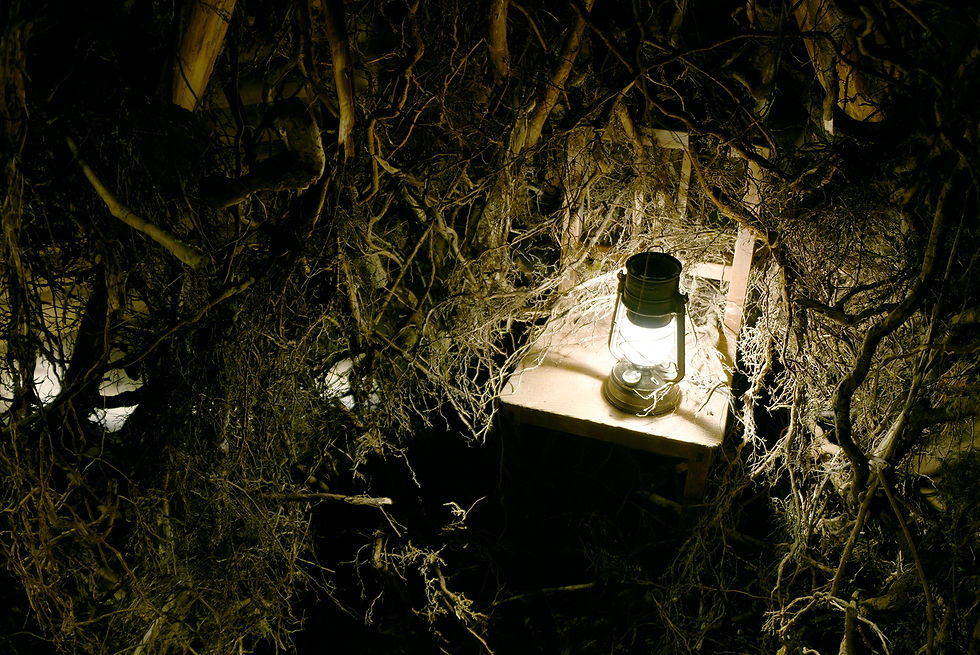
Tree roots, river water, folk tools, images,
Cooperation: Hokkaido University Wakayama Research Forest
2019
森の縁
At the Forest’s Edge
Hokkaido University Wakayama Research Forest (Wakayama)
Tree roots, river water, folk tools, images,
Cooperation: Hokkaido University Wakayama Research Forest
The Power of the Forest X
This work focuses on the long passage of time in which water circulates through rivers and seas, and the memories of the forests that have been sustained by forestry and charcoal making in their headwater areas. Nanjo has continued to create works that visualize the time accumulated in places, using the soil, sand, and water of the places he visits. In this work, based on his experience of the water cycle in the lower reaches of the Kozagawa River and his research at the Hokkaido University Wakayama Research Forest, he has created a space in the Shinrinkan building that allows visitors to touch upon the layers of time shared by the forest and water.


"Forest Edge" is an installation work that uses the water cycle from rivers to the ocean as its temporal axis, and reorganizes human activities such as forestry and charcoal making that have continued in the headwater areas through spatial composition. The setting, Hokkaido University's Wakayama Research Forest, is a place where traces of long-term changes in the natural environment and human intervention have accumulated in layers, and this work is positioned as an attempt to reinterpret its placeness as layers of time.
On the first floor of the Shinrinkan building, the Schlieren phenomenon, which occurs when freshwater and seawater mix in the lower reaches of a river, is visualized, making visible the invisible boundaries and movements inherent in the water cycle. The undulations and layers of sand on the floor, along with the water dripping from the ceiling, create subtle topographical changes over time, making the entire work not a static exhibit, but a creation process itself.
On the second floor, video and audio materials collected through field surveys are used to present the sense of time that has settled in the headwaters. What is dealt with here is not a reproduction of historical events, but rather layers of memory embedded in the forest environment, and viewers experience a nonlinear temporal structure through sight and sound.
The structure of this work, which allows viewers to experience the upper and lower floors in a continuous flow, connects geographically separated spaces through the time axis of the water cycle, prompting a re-examination of the relationship between nature and humanity not as a fixed conflict, but as a mutually permeating process. In this sense, "Forest Edge" demonstrates a methodology of contemporary art concerning environment and memory as a practice of spatializing the time accumulated in a place.