

2017
南条嘉毅個展 " overlay −時層の風景− "
Solo Exhibition " overlay "
GALLERY TAGA2 (Tokyo)
2017
南条嘉毅個展 " overlay −時層の風景− "
Solo Exhibition " overlay "
GALLERY TAGA2 (Tokyo)
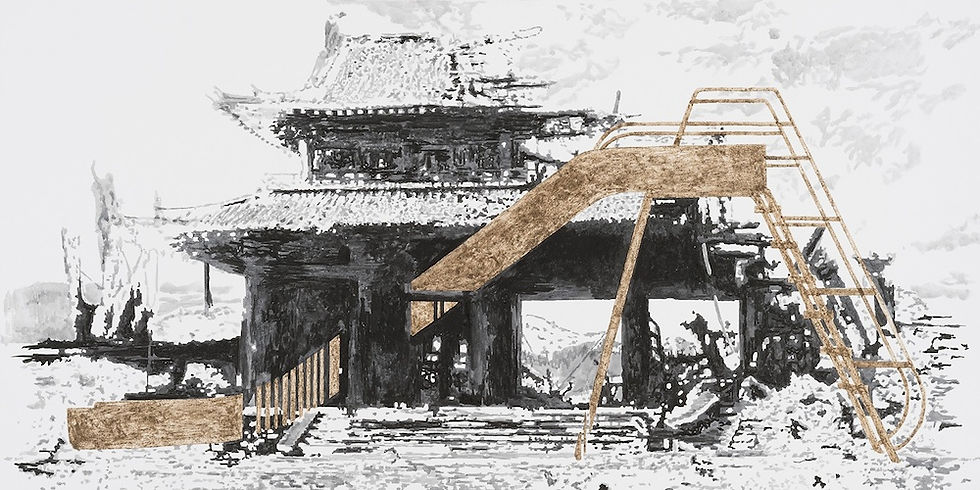
This exhibition features eight paintings created during the artist's residency in Kyoto. The works quietly intertwine the current landscape unfolding before the viewer with the traces of history lying dormant beneath the surface. Place does not appear as a fixed image, but rather as layers of overlapping timelines. The canvases, incorporating soil and materials themselves, gently guide the viewer into the depths of time, touching upon the memories settled within the city.


Encountering Time: On Yoshitaka Nanjo's "Time Layers" Series (Yuji Makino, Curator, Takamatsu Art Museum)
It may sound cliché, but Nanjo Yoshitaka's paintings transport the viewer's mind to a distant place. This is largely due to his technique of depicting nature and cityscapes with ample negative space. When we encounter a landscape that moves us, we try to capture it in a photograph, but usually it doesn't work. The cropped image of a photograph only conveys a small part of the charm of the actual landscape. In this respect, Nanjo's paintings, despite the bold compositional editing of the actual landscapes, are meticulously drawn using soil collected on-site, acrylic paints, and ink, and succeed in carefully representing even the intangible elements such as the atmosphere, the feeling, and the sensations that arise in the heart of the person who encounters the landscape. That is why our minds are easily warped to distant places such as the site of a climb of Mount Fuji or a pilgrimage to Ise. However, spatial movement is not the only characteristic of Nanjo's paintings. Temporal movement is also an important element. Nanjo uses fieldwork-based methods, analyzing what he sees, hears, and investigates in the places he visits, and incorporating this into his artwork. In the process, the history and memories of the place are firmly woven into the canvas. Through these images, we are led to contemplate the various flows of time that breathe life into the place, shaped by nature and human activity. In recent years, time has indeed become a major theme in Nanjo's paintings. The catalyst was his residency in Kyoto in 2016, where Nanjo was inspired by the fact that the remains of Heian-kyo, dating back 1200 years, lay beneath the site where he was working. He created a series of works that superimposed the appearance of Heian-kyo buildings such as the Rashomon Gate, Suzakumon Gate, and Daigokuden Hall in their heyday onto the modern-day location. Among these works, one that superimposed the dilapidated Rashomon Gate, which appears in Akira Kurosawa's film "Rashomon," onto a slide in the park that now stands on its site was created as a large-scale work exceeding 3 meters in width. The works to be exhibited in this solo exhibition are all part of this series, and will include a piece combining the octagonal nine-story pagoda, which stands over 80 meters tall and was built in the late Heian period, with the Ferris wheel at the zoo located on its site, as well as works based on Ogata Korin's Red and White Plum Blossoms, Utagawa Kunisada's Ishikawa Goemon, and Rakuchu Rakugai-zu (Scenes of Kyoto and its Surroundings). In September, he will be working on a residency in Paris and presenting his work there, and it will be very exciting to see how the history of the past and present intertwines against the backdrop of the ancient capitals of the East and West, which are both rich in historical events.
A message regarding the solo exhibition at GALLERY TAGA2 in June 2016