
Photo : Ken KATO
courtesy : Art Front Gallery
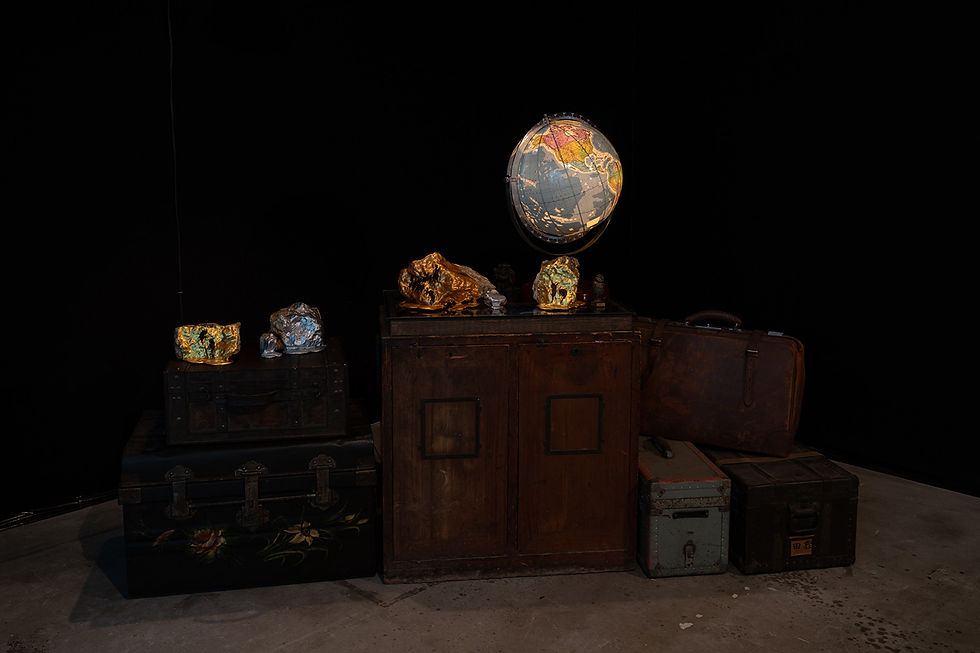
Photo : Ken KATO
courtesy : Art Front Gallery

Photo : Ken KATO
courtesy : Art Front Gallery
2019
南条嘉毅個展 " Roots of travel / 一雫の海 "
Solo Exhibition " Roots of travel / sea drop (Daikanyama) "
ART FRONT GALLERY (Tokyo)
Quartz, acrylic paint, furniture, etc.
Special lighting: Yasuhito Suzuki
Antiques: curio laboratory
2019
南条嘉毅個展 " Roots of travel / 一雫の海 "
Solo Exhibition " Roots of travel / sea drop (Daikanyama) "
ART FRONT GALLERY (Tokyo)
Quartz, acrylic paint, furniture, etc.
Special lighting: Yasuhito Suzuki
Antiques: curio laboratory
Photo : Ken KATO
courtesy : Art Front Gallery
Photo : Ken KATO
courtesy : Art Front Gallery
The vast geological time contained within quartz, and the faith and fervor accumulated in the land of Kumano—this work is an attempt to bring the process of crystallization and dissolution itself into space as a painting. Quartz is also used in clocks, and is a material that marks artificial "precise time." Drawing an analogy to cave paintings, the origin of painting, Nanjo paints directly onto the rock, making space itself part of the painting and visualizing time as a field of perception.


The Cluster series is an attempt to redefine the temporality and energy behavior inherent in the mineral quartz, by returning to the origins of painting. Quartz is a crystalline body formed over vast geological periods of time, and at the same time, it is a material that has supported humanity's modern measurement of time as a crystal oscillator. Nanjo focuses on this dual temporality—the historical time of the Kumano region supported by fervent faith, and the deep-seated time of matter that repeatedly undergoes crystallization and dissolution.
Time, passion, and concentrated energy crystallize on one hand, and dissolve on the other. Nanjo likens the continuous changes that occur over long periods of time to cave paintings, the origin of painting, and practices this by moving away from the canvas as a support and painting directly onto the rock. In this process, not only the painted image, but the rock itself and the space itself function as part of the painting.
Since the VOCA exhibition, Nanjo has consistently placed "place" at the core of his work, visualizing the accumulation of time through land-specific materials such as soil, salt, and quartz. The direct depiction of rocks in this work represents a critical point where his painting practice expands from two-dimensional to three-dimensional space while still remaining painting. It is the creation of a place where time is spatialized and space is perceived again as time, a practice that establishes painting as an event.
Yoshitaka Nanjo: The Gods of Kumano Smile with Grin (Hitoshi Nakano / Curator)
One day, Yoshitaka Nanjo received a treasure from his daughter that would give him the idea for his new exhibition. The object, which his daughter handed him and which glittered brightly in his palm, was quartz (crystal). This stone is one of the seven treasures in Buddhism, and in the ancient Mayan civilization, it was treated as a precious stone that could grant various wishes.
As a painter and visual artist, Nanjo's central concern is "place."
Generally known as an atelier or studio, it is a place where artists create their works and their ideas are embodied in sculptural forms, as well as the spatial nature of exhibition facilities such as museums and galleries where these works are displayed. Take Notre Dame Cathedral in Paris, a World Heritage site that was largely destroyed by fire in April 2019. As can be seen in the space surrounded by the paintings of saints on the walls of this massive religious structure, this "place" has been a place where many people have offered prayers over long periods of time, and the works of art there have become concrete, visual objects of our own prayers. This is where we can confirm the spatial nature that Nanjo is conscious of.
In 2017, the Oku-Noto Triennale was held in Suzu City, Ishikawa Prefecture, located at the tip of the Noto Peninsula. As an invited artist, he participated in the festival and used diatomaceous earth, a fossil of phytoplankton, as the material, based on the information that the festival site is the largest source of this material in Japan. For his exhibition, he created a dramatic installation using a closed movie theater, a place where the breath of local audiences who once confronted various dramas in this space still remains. And in this exhibition as well, Nanjo sought a sense of place in Kumano, Wakayama Prefecture, using quartz that his daughter found and brought back.
This exhibition is structured in two parts.
One aspect of the exhibition is the rediscovery and re-recognition of the history of this region, dating back to the 10th century with Emperor Uda and including the Kumano pilgrimage, which the artist came to possess through the use of quartz. Quartz is also a material used in clocks and can be considered a symbol of time. In Room-A, these elements are brought together in the exhibition space using projections and LED lights, creating a skillful relationship between light and sound.
Room-B is a work that incorporates his concept of place into the piece he will present at the Setouchi Triennale this year (2019). His hometown is Sakaide City in Kagawa Prefecture, which faces the Seto Inland Sea. Capturing the history of this area, where salt production once flourished, Nanjo attempts to evoke memories of Sakaide, both near and far, of time and place, as salt crystals suspended like ice pillars in a bottle slowly melt.
When I was in university, I had a friend from Shingu City, Wakayama Prefecture. Every year during summer vacation, he would invite me to stay at his family home, and we would stay at his main house in Hongu Town, which is located upstream from Shingu along the Kumano River. Staying at the main house, which was built in the Edo period, allowed us to have experiences we wouldn't normally have, such as grilling fish over a charcoal brazier, taking a bath in a Goemon-style bathtub, and sleeping under a mosquito net.
And each time I stayed there, I paid my respects to the gods of Kumano enshrined at Hongu Taisha, Hayatama Taisha, and Nachi Taisha, walked the Kumano Kodo trail, and was drenched in the fine spray of Nachi Falls. The forests were dense with trees. Light streamed in through the gaps in the branches. The Kumano River flowed brilliantly. There, one could experience the tranquil and secluded natural beauty unique to Kumano. And in this remote mountain region, we offered deep prayers to the gods.
Yoshitaka Nanjo will exhibit works that he has created, based on the historical, religious, geographical, and personal experiential elements of Kumano, the place where he currently resides, and captured with his keen perspective and sensibility.
The gods of Kumano, viewing this exhibition from afar, seem to be smiling gently, each with a different, serene expression, as they contemplate the future development of the artist and his work.